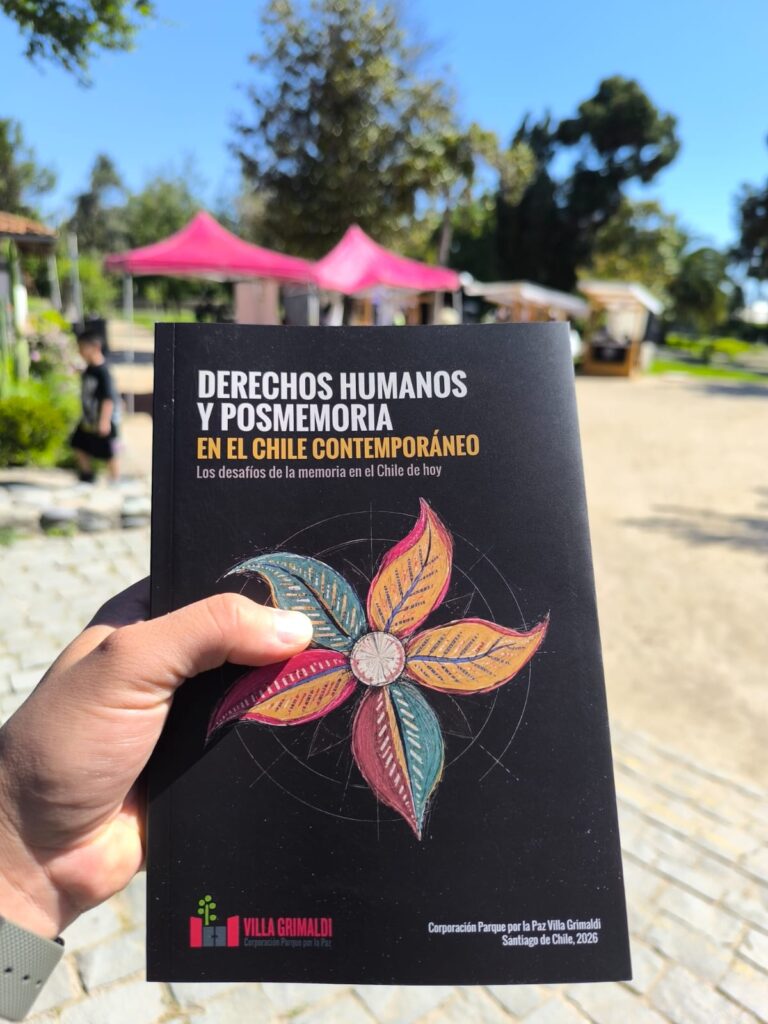
We contributed to the book *Human Rights and Post-Memory in Contemporary Chile: The Challenges of Memory in Today’s Chile*, published by the Villa Grimaldi Peace Corporation, which brings together academic reflections on memories of the recent past and the challenges they pose in the present.
The chapter “New Technologies and Analysis of Human Rights Violations in Chile” is the first publication dedicated to presenting and discussing the methodological proposal of NuestramemorIA. “We consider it particularly significant that one of our first outreach publications is being released in a space linked to a site of memory. This reflects the team’s desire for the knowledge generated by the project to extend beyond academic circles and become part of the debates and practices of those who work daily to promote memory and human rights,” notes Pablo Seguel, a researcher at NuestramemorIA and a postdoctoral fellow at the UAH.
Artificial Intelligence in the Service of Memory
NuestramemorIA It seeks to develop artificial intelligence systems that address the specific needs of social and human rights organizations. For this reason, the team works in close collaboration with various institutions to explore technologies that can help recover, organize, connect, and analyze document collections that—due to their volume, fragmentation, and heterogeneity—pose significant challenges for historical research and the processes of memory, truth, and justice.
“Artificial intelligence should be a tool at the service of people and organizations,” emphasizes the researcher, who holds a Ph.D. in History and a Master’s degree in History from the University of Santiago de Chile, as well as a degree in Sociology from the University of Chile. “To this end, we always work according to criteria of transparency, document traceability, and human oversight. It is crucial to recognize that these systems are far from being a substitute for historical interpretation or the knowledge accumulated by those who have worked with these archives for decades; rather, they should be tools that enhance the work of these individuals,” he adds.
NuestramemorIA It seeks to demonstrate that it is possible to develop artificial intelligence systems from an interdisciplinary perspective—one that is socially oriented and focused on governance—created in the Southern Cone to meet the region’s needs. “We seek to build tools in collaboration with human rights organizations, addressing their needs and recognizing their knowledge and experiences. We want the knowledge we produce to engage with society and contribute concretely to the processes of memory, truth, and justice,” emphasizes Pablo Seguel.