NuestramemorIA He presented his research findings at the International Seminar held by the Catholic University of Uruguay.
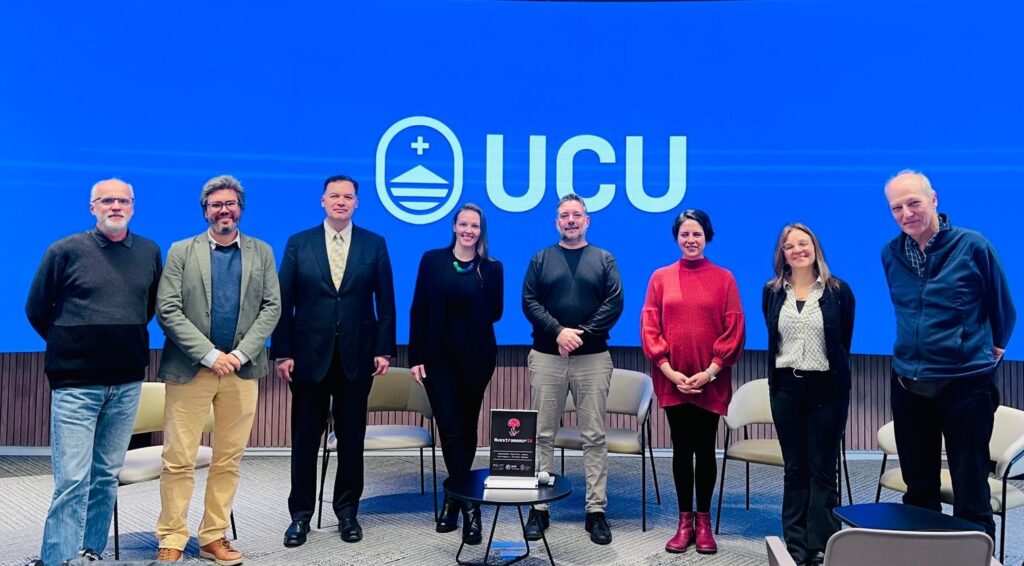
The major shift driven by the use of artificial intelligence tools in working with historical archives: this was the central theme of the International Seminar on Archives, Memory, and Artificial Intelligence, held at the Catholic University of Uruguay, which featured the participation of NuestramemorIA and researchers from Uruguay and the United States.
“The intersection of computer science and the humanities drives solutions that are scalable to fields such as healthcare and law,” notes Jocelyn Dunstan, regarding the work being done at NuestramemorIA. “These types of activities strengthen regional collaboration by building on a local and ethical foundation that protects the privacy of sensitive data. Not only is this critical for historical memory, but it also serves as a driver of technological development with an impact at the national and regional levels, since these tools can be scaled to areas as diverse as public health, general law, and administrative transparency.”
The Impact of Research: Innovation from Chile
The presentations by the “ NuestramemorIA ” team delved into the lines of research currently being developed within the project, which aim to expand the capacity for expert analysis through AI technologies. Domingo Mery, a faculty member at the DCC UC and a researcher on the project, gave a presentation on AI and image processing, showcasing preliminary results that enable the extraction of information from low-quality documents and the automation of the transcription of historical audio recordings. He highlighted the use of facial recognition in documentary footage to identify victims, as well as the use of georeferencing of movement paths to visualize sites of detention and disappearance during the Chilean dictatorship, and the collaborative work with organizations that maintain archives in Chile, such as the Museum of Memory.
Hugo Rojas, a professor at the Catholic University of Uruguay and Alberto Hurtado University, focused his presentation on the use of language models (LLMs) and knowledge graphs to organize information scattered across thousands of court documents. This work enables complex searches, identifies contradictions in testimony, and helps ensure that this technical data is accurately incorporated into popular culture and the public’s understanding of the issues.
Meanwhile, Jocelyn Dunstan, a researcher at IMC and DCC UC, focused on the use of the “human-in-the-loop” methodology, emphasizing that the successful development of AI applied to transitional justice requires humans to curate the information that feeds the models, annotate training datasets, evaluate responses, and identify the most appropriate uses for these technologies. She also explained that in our project, ethical annotation is crucial—ensuring fair treatment and adequate compensation for annotators—as well as using local models to guarantee the confidentiality of sensitive information and detect censored information in official records.
Regional Collaboration
In the first panel, “Archives of Repression and Transitional Justice: From Documentary Memory to Computational Evidence,” Santiago López Cariboni of the University of the Republic of Uruguay (UdelaR) also presented on the logic of authoritarian repression, from historical archives to big data. Elina Gómez, also from UdelaR, focused on the Cruzar project and discussed the methodological dilemmas and challenges involved in the computational processing of military archives from the Uruguayan dictatorship. Closing out the session was Pamela Izvănariu from the University of the Pacific – McGeorge School of Law, California, who spoke about her work using a racial and economic lens to explore the use of AI in analyzing historical court rulings currently underway in the United States.
The second panel of the afternoon, titled “Artificial Intelligence Methods for the Analysis of Historical Data: Text, Images, and Human Validation,” delved into the technical and ethical pillars underpinning regional research. In this session, Gregory Randall (UdelaR) analyzed the current status and future prospects of the Luisa Cuesta repository, a fundamental resource for consulting and preserving memory archives. Researchers from the UdelaR School of Engineering, Ignacio Ramírez and Lorena Etcheverry, shared their progress in image processing and in information extraction and representation techniques applied specifically to the Memory Project in Uruguay.
A Necessary Discussion
The participants in the panel discussions explored in depth how authoritarian regimes in the Southern Cone—and particularly in Uruguay—used a complex bureaucracy to target repression, relying on “signals” or information gathered about individuals to decide whom to monitor, persecute, or punish. The importance of local interdisciplinary research was also highlighted, such as the project linking political imprisonment to cancer, which uses computational tools to analyze military archives and construct a retrospective historical cohort. This effort seeks to generate scientific evidence on the effects of stress caused by torture by cross-referencing personal data with national epidemiological records, overcoming the challenges of accessing information and the complexity of intelligence archives.
In addition, the implementation of “human-in-the-loop” methodologies was discussed, emphasizing that artificial intelligence does not replace expert interpretation but rather expands upon it to handle massive volumes of data. They also shared advances in facial recognition in documentary evidence to identify missing victims and the use of knowledge graphs to systematize court records, making it possible to detect contradictions in the perpetrators’ accounts.
According t Domingo . Mery, “it is essential that these efforts be coordinated at the local level, prioritizing the development of local infrastructure and the use of open-source models that protect the privacy of sensitive data, while avoiding dependence on external cloud services.” By fostering close collaboration among researchers from Chile, Uruguay, and Argentina, the project not only seeks justice for the past but also builds regional technological sovereignty capable of addressing complex challenges with an ethical, collaborative approach grounded in our own reality.
“It is essential, particularly with regard to these issues, that our countries be able to develop technological sovereignty—which includes processing data on local servers to ensure confidentiality—and that this work be carried out by experts who are knowledgeable about both the management and scale of local archives and the historical memory of each of our countries,” says Hugo Rojas, highlighting the seminar’s relevance to the work of NuestramemorIA.